
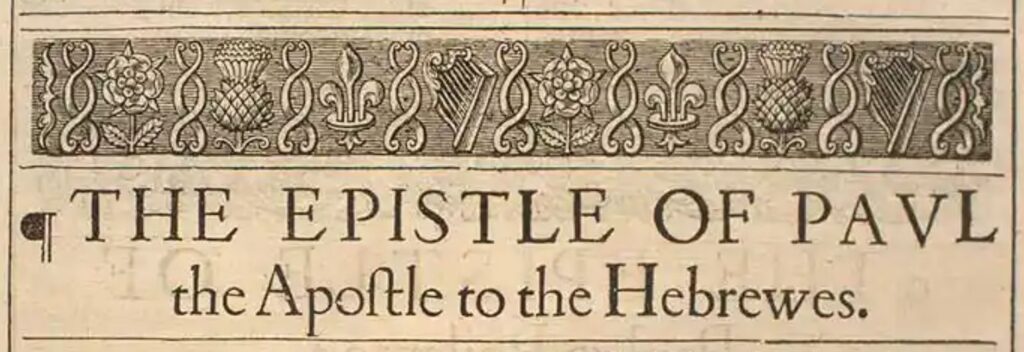
The book of Hebrews has long been a subject of intrigue and debate among biblical scholars. Who penned this profound epistle? While tradition often attributes it to Paul, a closer examination of the text and related scriptures reveals a compelling case for an unexpected author: John Mark.
To unravel this mystery, we must approach the text with fresh eyes, paying close attention to the subtle clues woven throughout. The author of Hebrews presents us with six key requirements that, when examined collectively, point us in a surprising direction.
Our investigation begins with six key requirements that the author of Hebrews must meet:
- Saved under the kingdom gospel.
- Did not personally hear Jesus Christ during His earthly ministry.
- Did not personally exercise the signs of an apostle.
- Had credibility with the “little flock” (the believing remnant of Israel).
- Performed ministry work alongside Timothy.
- The author was in Italy when Timothy was set at liberty.
First and foremost, the author was undoubtedly saved under the kingdom gospel. This immediately narrows our field of candidates to those who came to faith before Paul’s ministry to the Gentiles. The writer speaks intimately about the promises made to Israel, drawing his readers’ attention to things “God, who at sundry times and in divers manners spake in time past unto the fathers by the prophets,” (Hebrews 1:1).
Secondly, and perhaps most surprisingly, the author did not personally hear Jesus Christ during His earthly ministry. This eliminates the twelve apostles and others who walked with Jesus. The writer refers to the message of salvation as being “confirmed unto us by them that heard him” (Hebrews 2:3), placing himself in a second generation of believers.
Our third clue is that the author did not personally exercise the signs of an apostle. While he acknowledges God’s confirmation of the message “both with signs and wonders, and with divers miracles, and gifts of the Holy Ghost,” (Hebrews 2:4), he attributes these to others, not himself.
Fourth, the writer clearly had credibility with the “little flock” – the believing remnant of Israel. Throughout the epistle, he issues instructions with authority, exhorting his readers to “remember them which have the rule over you” (Hebrews 13:7) and to “obey them that have the rule over you” (Hebrews 13:17).
The fifth requirement narrows our search significantly: the author performed ministry work alongside Timothy. This connection to Paul’s close associate provides a crucial link between the kingdom gospel and the later revelation of the mystery of the church. Put another way, the author was conversant in both the prophetic and mystery programs.
Finally, our author was in Italy at the time Timothy was set at liberty (Hebrews 13:23). This geographical and temporal marker is perhaps the most specific clue of all, allowing us to pinpoint a particular moment in early church history.
As we sift through the potential candidates, many familiar names fall away. Matthias and Barsabbas are eliminated due to their direct connection with Jesus. Barnabas, Stephen, and Philip all exercised apostolic signs, disqualifying them. Even Aquila and Priscilla, though respected, lack the necessary authority with the little flock.
Who, then, meets all these criteria? The evidence points compellingly to John Mark.
Mark’s journey of faith aligns perfectly with the profile we’ve constructed. He was saved under the kingdom gospel, as evidenced by his early association with the Jerusalem church (Acts 12:12). Yet, he never claims to have personally heard Jesus or performed miraculous signs.
Mark’s credibility with the little flock is clear from his connection to Peter, who refers to him affectionately as “Marcus my son” (1 Peter 5:13). His ministry work with Timothy is confirmed in Paul’s letters, particularly in Colossians, where both are mentioned as co-laborers.
The final piece of the puzzle falls into place when we consider Paul’s last recorded words to Timothy: “Only Luke is with me. Take Mark, and bring him with thee: for he is profitable to me for the ministry.” (2 Timothy 4:11). This request, made from a Roman prison, sets the stage for John Mark and Timothy to be together in Italy – precisely the scenario described in Hebrews 13:23-24.
This insight about authorship sheds new light on the purpose and timing of Hebrews. Written after the close of Acts, it represents a bridge between the kingdom gospel and the full revelation of the mystery of the church. John Mark, having experienced both, was uniquely positioned to explain to Jewish believers how Christ’s work applied to their future in light of Israel’s temporary setting aside.
The implications of this are profound. Hebrews is not merely a theological treatise, but a pastoral letter addressing a community in transition. It explains how the promises made to Israel find their ultimate fulfillment in Christ, while also preparing the “little flock” for a future different from what they initially expected.
This understanding invites us to read Hebrews with fresh eyes. We see a writer intimately acquainted with the struggles and questions of his audience, offering them a new perspective on their faith. He exhorts them to endure, not in pursuit of an imminent earthly kingdom, but in light of the “world to come” (Hebrews 2:5) and the heavenly rest that awaits them.
The book’s emphasis on the superiority of Christ takes on new significance when we consider Mark’s journey. Having witnessed the power of the kingdom gospel and later coming to understand the full implications of the cross through Paul’s ministry, he presents Jesus as the fulfillment of all God’s promises – past, present, and future.
As we reflect on this, we’re reminded of the beautiful complexity of God’s plan. The same Lord who spoke to the fathers through the prophets has now spoken to us by His Son (Hebrews 1:1-2). This Son, the brightness of God’s glory and expresses image of his person, is the one who sustains all things by the word of His power (Hebrews 1:3).
In light of this, the exhortations of Hebrews take on renewed urgency for us today. We too are called to “give the more earnest heed to the things which we have heard, lest at any time we should let them slip” (Hebrews 2:1). We’re reminded to “hold fast the confidence and the rejoicing of the hope firm unto the end” (Hebrews 3:6).
As we navigate our own times of transition and uncertainty, Hebrews offers us a steadfast anchor. It reminds us that Jesus Christ who is “the same yesterday, and to day, and for ever.” (Hebrews 13:8). In Him, we find a high priest who “was in all points tempted like as we are, yet without sin.” (Hebrews 4:15). Through Him, we can “come boldly unto the throne of grace, that we may obtain mercy, and find grace to help in time of need” (Hebrews 4:16).
May we, like the original recipients of this letter, press on toward maturity in our faith. “. . . let us run with patience the race that is set before us, Looking unto Jesus the author and finisher of our faith; who for the joy that was set before him endured the cross, despising the shame, and is set down at the right hand of the throne of God. (Hebrews 12:1-2). And may we continually “offer the sacrifice of praise to God, . . . that is, the fruit of our lips giving thanks to his name. (Hebrews 13:15).
The mystery of Hebrews’ authorship serves as a beautiful reminder of God’s intricate workings in history. It challenges us to dig deeper into Scripture, to pay attention to details, and to always be ready to adjust our understanding in light of new evidence. Most importantly, it calls us to a renewed appreciation of Christ’s supremacy and the enduring relevance of God’s word in our lives.
Pastor Bryan Ross
Grace Life Bible church
Grand Rapids, MI
August 12, 2025
Resources For Further Study
1) Authorship: Who Wrote Hebrews? (YouTube Video)
2) Authorship: Who Wrote Hebrews? Part 2 (YouTube Video)