
(Note: the research for this article was taken from Lesson 22 of the Come Let Us Reason Together class taught a Grace Life Bible Church on Sunday, October 5. This link provides the source citations for the various points summarized in this article. Also consider reading Arnold D. Elhert’s A Bibliographic History of Dispensationalism in its entirety by clicking here.)
In the vast landscape of Christian theology, few topics have sparked as much debate and discussion as dispensationalism. Yet, despite its critics, this theological framework offers profound insights into God’s progressive revelation and His unique dealings with humanity throughout history.
At its core, dispensationalism recognizes that God has interacted with His creation in distinct ways during different periods or “dispensations.” This concept is not a modern invention, as some might claim, but finds its roots in Scripture itself. The Apostle Paul uses the Greek word “oikonomia” (translated as “dispensation” in the King James Bible) multiple times in his letters, pointing to God’s orderly management of His household affairs throughout time.
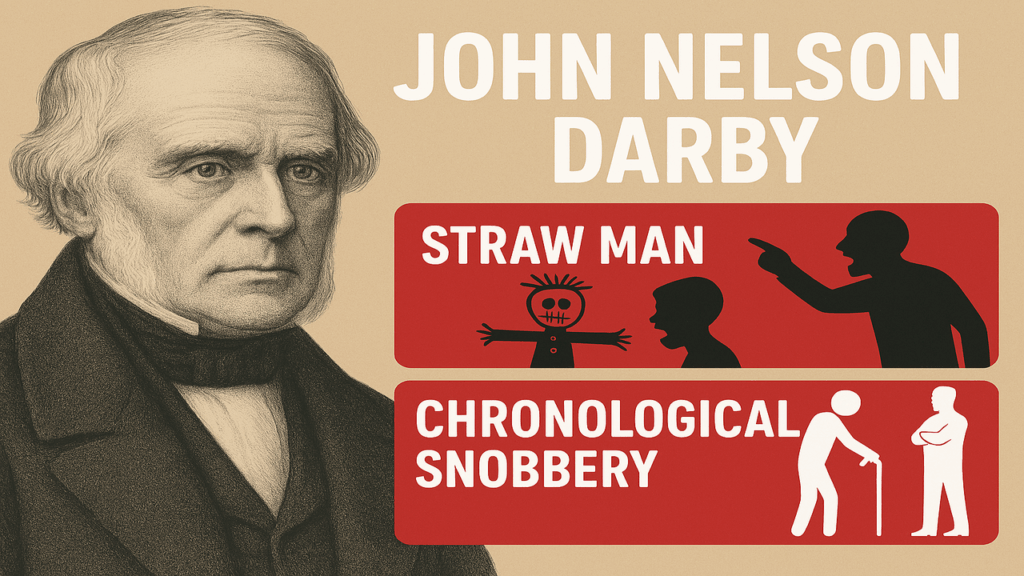
Critics often argue that dispensationalism is a relatively recent theological development, emerging only in the 19th century with figures such as John Nelson Darby. However, a closer examination of church history reveals that dispensational concepts have been present in Christian thought for centuries. (Note: all the research for this article was taken from Lesson 22 of the Come Let Us Reason Together class taught a Grace Life Bible Church on Sunday, October 5. The following link provides the s
As early as the 2nd century AD, Justin Martyr acknowledged that God had different instructions for various groups of people at different times. Irenaeus, writing between 130-200 AD, outlined four distinct covenants given to humanity: one before the flood (under Adam), one after the flood (under Noah), the giving of the law (under Moses), and finally, the covenant that “resonates with man and sums up all things” (presumably referring to the New Covenant in Christ).
Even Augustine, whose writings have profoundly shaped Western Christianity, reflected on how divine institutions suitable for one age might be rightly changed in another. He recognized God’s sovereignty in ordering all events “unto the beauty of the completed course of time.”
As we journey through church history, we encounter numerous theologians and writers who grappled with the idea of God’s progressive revelation and distinct epochs in His dealings with humanity. From Jonathan Edwards to Isaac Watts, these thinkers sought to understand and articulate how God’s redemptive plan unfolded across the ages.
Isaac Watts, the renowned hymn writer, outlined six dispensations that bear a striking resemblance to later, more systematized forms of dispensationalism, such as the system of C.I. Scofield in the Scofield Reference Bible. Watts recognized the dispensation of innocence, the Adamical dispensation after the fall, the Noahic, Abrahamic, and Mosaic dispensations, culminating in the Christian dispensation.
Interestingly, Watts also noted that the Christian religion “was not properly set up in the world during the life of Christ,” recognizing that many of its “particular glories, duties, and blessings” depended on events that occurred after Christ’s earthly ministry – His death, resurrection, ascension, and exaltation.
This historical survey serves not only to refute claims of dispensationalism’s novelty but also to invite us into a deeper appreciation of God’s wisdom in His progressive revelation. As we contemplate these truths, we’re reminded of Paul’s words in Ephesians 1:9-10: “Having made known unto us the mystery of his will, according to his good pleasure which he hath purposed in himself: That in the dispensation of the fulness of times he might gather together in one all things in Christ, both which are in heaven, and which are on earth; even in him:”
Dispensationalism, far from being a cause for division, offers a framework for understanding the rich tapestry of God’s redemptive plan. It reminds us that while God Himself is unchanging, His methods of dealing with humanity have varied according to His “eternal purpose.” (Eph. 3:10)
Critics often charge dispensationalism with promoting separatism or divisiveness within the church. However, this critique fails to recognize that ecclesiastical separation is not inherently wrong. The Protestant Reformation itself was a separatist movement, yet few would argue against its importance in church history. The validity of a theological system should be judged not by its potential for causing organizational division, but by its faithfulness to Scripture.
Moreover, it’s crucial to note that dispensationalism is not alone in being a relatively recent systematic theological framework. Covenant theology, often positioned as the main alternative to dispensationalism, did not emerge as a fully developed system until the 17th century. The Westminster Confession of 1647 was the first major confession of faith to incorporate covenant theology, and even then, it was not as fully developed as it would later become.
This realization should humble us all. It reminds us that our theological systems, while valuable tools for understanding God’s Word, are human attempts to systematize divine truth. They should always be held with an open hand, subject to the scrutiny of Scripture.
As we reflect on these truths, let us be encouraged to approach our study of God’s Word with humility and wonder. Dispensationalism invites us to marvel at the intricate ways God has revealed Himself throughout history, culminating in the person and work of Jesus Christ. It challenges us to read Scripture with careful attention to context, recognizing that while all Scripture is inspired and profitable, not all of it may be directly applicable to our current dispensation.
Let us then press on, studying to show ourselves approved, rightly dividing the word of truth (2 Timothy 2:15). May our increased understanding of God’s dispensations lead us not to pride, but to deeper worship, more effective ministry, and a greater appreciation and understanding of God’s word and His plan for the ages.
Pastor Bryan Ross
Grace Life Bible Church
Grand Rapids, MI
October 7, 2025
Resources For Further Study
Fallacies Regarding Dispensationalism, Part 2 (Straw Man & Chronological Snobbery)