
In our journey through Scripture, we often encounter ideas that challenge our understanding of God’s plan for humanity. One such concept that has sparked debate and discussion is dispensationalism. But what if much of the criticism surrounding this theological framework is based on misconceptions and logical fallacies? Today, let’s explore the truth behind dispensationalism and why it matters for our faith.
At its core, dispensationalism is not a new invention or a modern theological fad. It’s a way of understanding God’s progressive revelation and His dealings with humanity throughout history. The Greek word “oikonomia,” translated as “dispensation” or “stewardship,” appears multiple times in the New Testament, particularly in the writings of the Apostle Paul.
In Luke 16, we find Jesus telling the parable of the unjust steward, using the concept of stewardship (oikonomia) to illustrate spiritual truths. Paul, in 1 Corinthians 9:17, speaks of a “dispensation of the gospel” committed to him. In Ephesians 1:10, he mentions the “dispensation of the fullness of times,” and in Ephesians 3:2, he refers to the “dispensation of the grace of God” given to him for the Gentiles.
These scriptural references show that the concept of dispensations is not a recent invention but has been present in God’s Word from the beginning. What happened in the 19th century with figures like John Nelson Darby was not the creation of a new doctrine, but rather a systematic organization of truths that had always been present in Scripture.
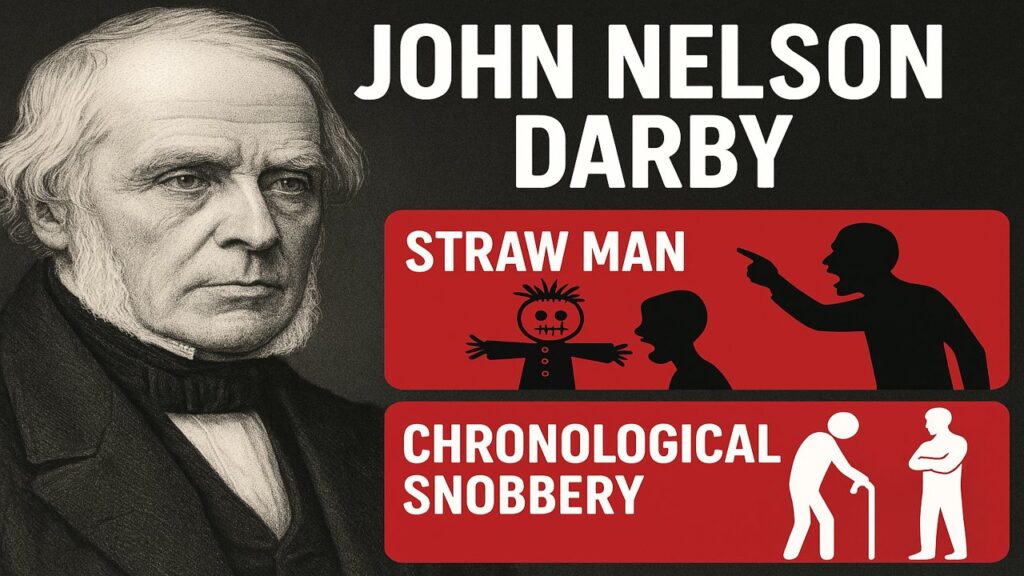
Critics often employ two fallacious arguments against dispensationalism: the straw man fallacy and chronological snobbery. The straw man fallacy involves misrepresenting or oversimplifying an argument to make it easier to attack. Chronological snobbery, a term coined by C.S. Lewis, is the assumption that newer ideas are inherently superior to older ones, or vice versa (See Surprised by Joy (1955) pages 206-208).
Some argue that dispensationalism can’t be true because it wasn’t “invented” until the 19th century. But this argument fails on multiple levels. First, it ignores the clear biblical evidence for dispensational concepts. Second, it commits the fallacy of chronological snobbery by assuming that the age of an idea determines its validity.
If we applied this same logic to other theological concepts, we’d have to reject many core Christian doctrines. For instance, the doctrine of justification by faith alone, central to the Protestant Reformation, wasn’t systematically articulated until the 16th century. Does that make it any less true or biblical? Of course not. As John Calvin astutely pointed out, when truth is restored to us by God’s goodness, “its claim to antiquity ought to be admitted at least by right of recovery.”
Moreover, historical research reveals that dispensational concepts were not absent from church history before the 19th century (See Arnold D. Ehlert’s A Bibliographic History of Dispensationalism). Ehlert and others have traced elements of dispensational thinking through various Christian writers and thinkers throughout the centuries. The idea that God deals with humanity in distinct epochs or “dispensations” can be found in embryonic form in many early church fathers and medieval theologians.
Interestingly, even ancient pagan cultures seemed to have grasped elements of this biblical framework. Various traditions, from Babylonian to Egyptian to Persian, held beliefs about the world lasting for 6,000 years, followed by a golden age or millennium. While these beliefs were often mixed with error, they suggest an underlying awareness of God’s dispensational plan that had permeated various cultures.
In Jewish tradition, we find similar ideas. Some rabbis taught that the world would experience 2,000 years without the law, 2,000 years under the law, and 2,000 years under the Messiah, followed by a sabbatical millennium. This bears a striking resemblance to the dispensational understanding of God’s dealings with humanity.
The truth is, God has always been a dispensationalist, regardless of human understanding or systematization of the concept. His Word reveals a progressive unfolding of His plan, with distinct economies or “dispensations” through which He relates to and governs His creation.
What does this mean for us today? It reminds us of the importance of careful, contextual Bible study. We must be willing to let Scripture speak for itself, rather than imposing our preconceived notions or traditions upon it. Dispensationalism, rightly understood, helps us appreciate the unity and diversity of God’s “eternal purpose” (Eph. 3:11).
It also challenges us to be discerning in our approach to theological arguments. We must be wary of logical fallacies and straw man arguments that distort or misrepresent biblical truth. Instead, we should strive to understand different perspectives charitably and evaluate them based on their biblical merit, not their age or popularity.
As we continue to study God’s Word and seek to understand His ways, let’s approach dispensationalism with an open mind and a humble heart. Let’s not be swayed by fallacious arguments or chronological snobbery, but instead, let’s dig deep into Scripture, allowing the Holy Spirit to illuminate its truths to us.
In the end, our goal should not be to win theological debates or prove others wrong. Rather, we should seek to grow in our understanding of God’s Word and His redemptive plan for humanity. By doing so, we can better appreciate the richness of His grace, the wisdom of His ways, and the glory of His ultimate purpose in Christ Jesus.
May we, like the Bereans of old, search the Scriptures daily, testing all things and holding fast to what is good. In doing so, we will not only grow in our knowledge of God’s dispensational plan but also in our love for Him and our effectiveness in serving the body of Christ.
Pastor Bryan Ross
Grace Life Bible Church
Grand Rapids, MI
September 30, 2025
Resources For Further Study
Fallacies Regarding Dispensationalism (Straw Man & Chronological Snobbery)