
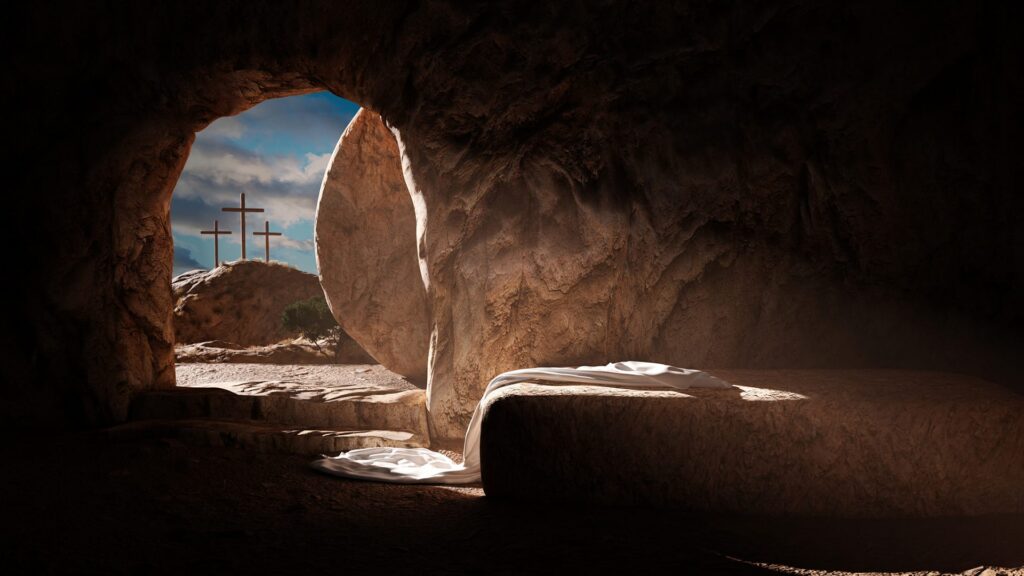
The resurrection of Jesus Christ stands as the pivotal moment in all of human history. Without it, faith crumbles, hope vanishes, and humanity remains trapped in sin. Yet with it, everything changes. The empty tomb discovered two thousand years ago in first-century Palestine continues to reverberate through time, offering every person the assurance of eternal life and victory over death.
The Gospel in Its Simplest Form
At its core, the Christian message is beautifully simple: God loves you. Christ died for your sins. He was buried. He rose again on the third day, victorious over sin and death. When you place your faith in this truth—and this truth alone—God gives you eternal life as a free gift.
This isn’t about saying the right words, performing certain rituals, or earning God’s approval through good behavior. The finished work of Christ is exactly that: finished. Complete. There’s nothing left undone, no stone unturned, nothing you can add to make God happier with you. Your forgiveness and righteousness before God rest entirely on what Christ accomplished through His death, burial, and resurrection.
And here’s the remarkable truth: your eternal life doesn’t begin when you die. It starts the very moment you receive it as a gift from Jesus Christ.
The Historical Reality No One Can Deny
Even the most skeptical scholars acknowledge twelve undisputed facts about Jesus of Nazareth:
Jesus died by Roman crucifixion. He was buried in a private tomb. His disciples were devastated and hopeless after His death. The tomb was found empty shortly after His burial. The disciples experienced what they believed were actual appearances of the risen Jesus. These experiences transformed them from fearful deserters into bold proclaimers willing to die for their beliefs.
The proclamation of resurrection began immediately in early church history. This preaching occurred in Jerusalem itself—the very city where Jesus was crucified and buried. If the body was still there, authorities could have easily produced it and ended the movement. The gospel message centered on Christ’s death and resurrection. Sunday became the primary day of worship, commemorating His rising on the first day of the week. James, Jesus’ skeptical brother, converted after believing he saw the risen Christ. And Saul of Tarsus, a fierce persecutor of Christians, became a believer after encountering the risen Christ.
These aren’t disputed religious claims—they’re agreed-upon historical facts.
The Empty Tomb Demands an Explanation
The religious leaders of Jesus’ day understood the implications of His promise to rise again. They went to Pilate requesting guards be stationed at the tomb, specifically to prevent the disciples from stealing the body and claiming resurrection. They sealed the stone and set a watch with elite Roman soldiers—men whose expertise was killing and securing.
The location of Jesus’ grave was known by Roman authorities, Jewish leaders, and His followers. This was perhaps the most well-known burial site in history. Yet three days later, it was empty.
Skeptics have proposed various theories over the centuries: mass hallucinations, the wrong tomb, the swoon theory (that Jesus didn’t actually die), or a stolen body. Each theory collapses under scrutiny. Hallucinations aren’t shared by large groups. Everyone knew the correct tomb location. Roman executioners were professionals who confirmed death. And a brutalized, barely-alive Jesus couldn’t have unwrapped burial cloths, rolled away a massive stone, and overpowered trained guards.
The most logical, plausible explanation remains the biblical account: Jesus actually rose from the dead.
Understanding How Resurrection Works
First Corinthians 15 doesn’t just affirm resurrection—it explains the mechanics of how it works through a powerful analogy from nature.
When you plant a seed in the ground, that seed must die and decompose to release the life embedded within it. Jesus Himself taught this principle: “Except a corn of wheat fall into the ground and die, it abideth alone: but if it die, it bringeth forth much fruit.” (John 12:24)
The seed sown into the earth isn’t the same as what emerges. There’s both discontinuity and continuity. The original seed dies and disintegrates, yet the new plant that springs forth carries the same essential nature—corn produces corn, wheat produces wheat, apple seeds produce apple trees.
This is the pattern of human resurrection.
Your current body is corruptible, subject to decay and death. When you die, your body is “sown” into the earth in corruption, dishonor, and weakness. But if you belong to Christ, you will be raised in incorruption, glory, and power. You sow a natural body; you’re raised a spiritual body.
Just as God designed every seed to reproduce “after his kind,” He has designed resurrection to transform our earthly, terrestrial bodies into heavenly, celestial ones suited for eternal existence.
The Promise for Every Believer
Scripture makes clear: flesh and blood cannot inherit the kingdom of God. Our current corruptible bodies aren’t suited for eternity. Whether we die before Christ returns or are alive when He comes, we all need to be changed.
“Behold, I show you a mystery. We shall not all sleep, but we shall all be changed, in a moment, in the twinkling of an eye, at the last trump: for the trumpet shall sound, and the dead shall be raised incorruptible, and we shall be changed.” (I Corinthians 15:51-52)
For those who have died trusting in Christ, their bodies were sown in corruption but will be raised incorruptible. For those alive at His return, transformation will be instantaneous. Either way, every believer receives a glorified body fashioned like Christ’s own resurrected body.
This is the hope that should comfort us when we lose loved ones who died in faith. The same power God demonstrated when He raised Christ from the dead—that exceeding greatness of power—extends toward every member of His church.
Living as Celestial Thinkers
The reality of resurrection should fundamentally change how we think and live today.
If you’ve been raised with Christ, you’re already positionally seated with Him in heavenly places. Your conversation is in heaven. Your true home is above, where Christ sits at the right hand of God.
The question becomes: What kind of thinker are you? Do you set your affection on terrestrial things—the temporary, earthly concerns that consume so much mental energy? Or are you a celestial thinker, focusing on the eternal realities of your union with Christ?
This doesn’t mean neglecting earthly responsibilities, but it does mean maintaining proper perspective. Your body and existence on planet Earth are temporary. God has far greater plans for you in the heavenly places with Christ.
The Victory Is Yours
The empty tomb changes everything. It’s not ancient history but living hope that transforms both present and future. Because Christ rose, you can know with certainty that death has been defeated, sin has been conquered, and eternal life is freely offered.
Your forgiveness doesn’t depend on your performance. Your acceptance before God doesn’t rest on your efforts. Everything necessary for your salvation was accomplished when Christ died, was buried, and rose again.
Stop striving. Stop trying to earn what’s freely given. Simply trust in what He’s done for you.
The resurrection is real. The tomb is empty. And because of that one morning in history, you can live victoriously today and face tomorrow—and eternity—with unshakable confidence.
Pastor Bryan Ross
Grace Life Bible Church
Grand Rapids, MI
Friday, April 4, 2026
Resources For Further Study
How Are the Dead Raised Up? (Easter 2025)
Reaffirming The Reality Of The Resurrection (Blog Article)