
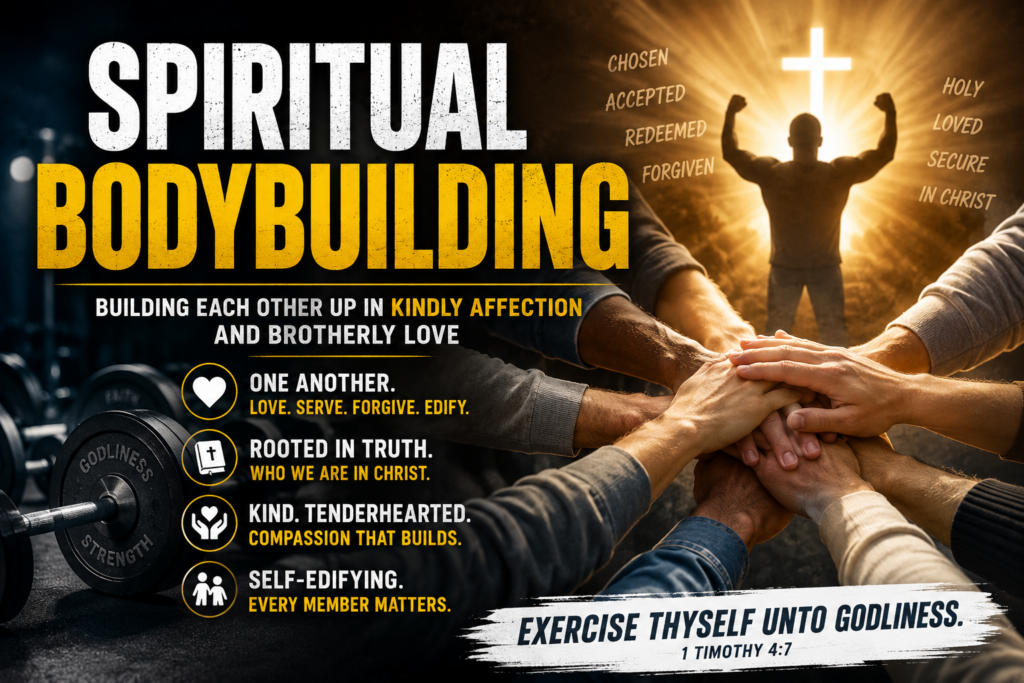
When we think about bodybuilding, our minds naturally drift to gyms, weights, and physical transformation. But what if the most important bodybuilding we could engage in has nothing to do with our physical muscles? What if the body that needs the most attention, the most intentional development, is actually a spiritual one?
The concept of spiritual bodybuilding centers on a profound truth: the church, the body of Christ, is designed to be self-edifying. Just as physical bodybuilding requires regular exercise and effort, spiritual growth demands intentional practice and cultivation of specific virtues.
The Exercise of Godliness
Scripture tells us to “exercise thyself unto godliness” (1 Timothy 4:7). This isn’t a passive suggestion—it’s an active command. Godliness requires work, effort, and intentionality. Just as someone committed to physical fitness doesn’t accidentally stumble into peak condition, believers don’t accidentally grow in spiritual maturity.
The Apostle Paul instructs us to “work out your own salvation with fear and trembling” (Philippians 2:12). This isn’t about earning salvation—that’s a free gift of God’s grace—but about taking the life Christ has placed within us and manifesting it outwardly through our actions, attitudes, and relationships.
Understanding Who We Are in Christ
Before we can effectively build up others, we must understand our own spiritual identity. Scripture reveals that believers possess all spiritual blessings in heavenly places in Christ (Ephesians 1:3). These aren’t future promises—they’re present realities.
In Christ, we are:
- Chosen
- Holy and without blame
- Accepted in the Beloved
- Redeemed
- Forgiven
These truths aren’t dependent on how we feel or what our past looks like. They’re objective facts about our spiritual position. The challenge lies in reckoning these truths to be so—agreeing with God about who we actually are and then yielding our lives to that reality.
Many believers struggle with accepting these truths because years of negative thinking have created patterns that contradict God’s Word. The mind must be renewed (Romans 12:2) to align with spiritual reality. This requires knowing the truth, reckoning it to be true, and then yielding to it in daily life.
The One-Anothering Principle
At the heart of spiritual bodybuilding lies what can be called “the one-anothering principle.” This concept appears throughout Paul’s letters—the words “one” and “another” occur together 110 times in 44 verses in his epistles. This repetition isn’t accidental; it reveals a fundamental principle of how the body of Christ is designed to function.
The idea of “one another” is reciprocal—mutual actions done by each to the other. It’s the spiritual equivalent of “I scratch your back, you scratch mine,” but with far more profound implications.
Scripture instructs believers to:
- Love one another
- Prefer one another
- Receive one another
- Admonish one another
- Serve one another
- Bear one another’s burdens
- Forgive one another
- Comfort one another
- Edify one another
These aren’t suggestions for super-spiritual believers; they’re the normal operating procedures for the body of Christ.
The Foundation: Kindly Affectionate with Brotherly Love
The first positive instruction regarding one-anothering appears in Romans 12:10: “Be kindly affectionate one to another with brotherly love; in honor preferring one another.”
Being “kindly affectionate” represents a disposition of heart whose goal is to make others happy and to treat them favorably with goodwill. This doesn’t come naturally to our flesh. Our default setting, shaped by years in a self-centered world system, is to look out for ourselves first.
The expression “brotherly love” translates the Greek word “Philadelphia”—the same word that gives Philadelphia its nickname as “the city of brotherly love.” This concept appears throughout the New Testament as the love believers ought to have for one another.
Interestingly, this is something we must be taught by God (1 Thessalonians 4:9). It’s not intuitive; it requires the work of the Holy Spirit in our lives to develop this kind of love.
From Vice to Virtue
Ephesians 4:31-32 provides a powerful contrast between fleshly vices and spiritual virtues. Verse 31 lists what must be put away: bitterness, wrath, anger, clamor, evil speaking, and malice. These are the toxic elements that poison relationships within the body of Christ.
But we can’t simply eliminate negative behaviors; we must replace them with positive ones. Verse 32 provides the antidote: “And be ye kind one to another, tenderhearted, forgiving one another, even as God for Christ’s sake hath forgiven you.”
Notice the progression: put away the negative, then actively cultivate the positive.
God’s Kindness as Our Model
Our model for kind behavior toward other believers is found in God’s treatment of us. Titus 3:3-4 reminds us that we were once foolish, disobedient, deceived, serving various lusts, living in malice and envy, hateful and hating one another. “But after that the kindness and love of God our Savior toward man appeared.”
God was kind to us when we were at our worst. He showed mercy when we deserved judgment. He extended grace when we could offer nothing in return. This divine kindness should inspire and shape how we treat fellow members of the body of Christ.
The Tenderhearted Imperative
Being tenderhearted means being susceptible to the softer passions—love, pity, and kindness. In the context of the body of Christ, tenderheartedness means showing compassion when other believers exhibit the very faults listed in Ephesians 4:31.
We must recognize that we’re all capable of the same failures. Galatians 6:1 warns: “Brethren, if a man be overtaken in a fault, ye which are spiritual, restore such an one in the spirit of meekness; considering thyself, lest thou also be tempted.”
The moment we need to address someone else’s fault, we become vulnerable to the same temptation. This awareness should keep us humble and compassionate.
The Challenge Before Us
If members of the body of Christ show more kindness to strangers than to fellow believers, something is fundamentally wrong. Our relationships within the household of faith should be characterized by tender affection, warmth, acceptance, and mutual support.
The body of Christ is designed to be self-edifying—building itself up through the contribution of every member. This requires intentional spiritual exercise, the cultivation of kindly affection, and the practice of brotherly love.
The question isn’t whether we’ll need to work at this—we will. The question is whether we’re willing to engage in the spiritual exercise necessary to become true bodybuilders in the church, the body of Christ.
Pastor Bryan Ross
Grace Life Bible Church
Grand Rapids, MI
Friday, June 12, 2026
Resources For Further Study
2) Body Building: Kindly Affectioned One to Another (YouTube Video)