
Abstract
Matthew Verschuur’s defense of the Pure Cambridge Edition (PCE) appeals to Galatians 3:16 as evidence that “every letter matters” for doctrinal precision. While Paul’s argument in this verse hinges on the singular “seed” versus plural “seeds,” this distinction originates in the inspired Greek text. This article demonstrates that using Galatians 3:16 to justify the exclusivity of one English edition constitutes a category error: it conflates original-language precision with orthographic refinements in translation. Logical analysis reveals that spelling and punctuation differences among King James Bible editions do not carry doctrinal weight comparable to the singular/plural distinction in the Hebrew and Greek. By exposing this non-sequitur reasoning, the article affirms that fidelity to the original languages—not adherence to one exact English edition—is the legitimate principle for doctrinal accuracy.
[Sources: Verschuur, “Bryan Ross’ Attempted Fire Storm,” Dec. 6, 2025]
Introduction
In his defense of the PCE, Matthew Verschuur appeals to Galatians 3:16 as evidence that “every letter matters” for doctrinal precision.
“But in that a letter changes doctrine, in a verse, in context, that is evident: “Now to Abraham and his seed were the promises made. He saith not, And to seeds, as of many; but as of one, And to thy seed, which is Christ.” (Galatians 3:16).
So, a letter does make a difference. When we look at editorial variations, we would not be so foolish as to not correct typographical errors, and we would be not so foolish as to insist that “I will pour out my spirit upon all flesh” (in Joel 2:28) is identical or else meaninglessly distinct to “I will pour out of my Spirit upon all flesh” (in Acts 2:17). Every word matters, every capital letter matters, even dots matter.”
At first glance, this seems persuasive: Paul’s argument in that verse hinges on the difference between “seed” (singular) and “seeds” (plural). However, using this example to justify the necessity of one exact English edition is a logical misstep. This article explains why.
What Galatians 3:16 Actually Demonstrates
Paul writes:
“Now to Abraham and his seed were the promises made. He saith not, And to seeds, as of many; but as of one, And to thy seed, which is Christ.” (Galatians 3:16)
Paul’s reasoning in Galatians 3:16—“to Abraham and his seed were the promises made… not to seeds… but as of one”—draws directly from the covenant promises in Genesis. Key passages include Genesis 12:7, “Unto thy seed will I give this land”; Genesis 13:15, “To thee will I give it, and to thy seed for ever”; Genesis 17:7, “I will establish my covenant between me and thee and thy seed after thee”; and Genesis 22:18, “In thy seed shall all the nations of the earth be blessed.” In each case, the Hebrew word for “seed” is זֶרַע (zera‘), which is grammatically singular, even though it can function as a collective noun. Paul leverages this singular form to argue that the promise ultimately points to one seed—Christ (Gal. 3:16). This demonstrates that the theological weight of his argument rests on the inspired Hebrew and Greek wording.
The argument in Galatians 3:16 hinges on a grammatical distinction—the singular “seed” versus the plural “seeds”. This contrast originates in the inspired Hebrew (זֶרַע, zera‘) and Greek (σπέρμα, sperma), both of which are singular in form. Paul uses this grammatical singularity to make a Christological point: the promise refers to one seed, Christ. Spelling differences such as alway versus always or stablish versus establish do not affect grammatical number or meaning and therefore carry no doctrinal weight.
Galatians 3:16 is grounded in the fact that Moses consistently used the singular Hebrew word זֶרַע (zera‘, “seed”) in the covenant promises to Abraham (Gen. 12:7; 13:15; 17:7; 22:18). This choice was not inevitable—Moses had other words available to denote plurality, such as בֵּן (ben, “children,” Gen. 3:16) or תּוֹלְדוֹת (toldot, “generations,” Gen. 5:1), both of which he used elsewhere in Genesis. If the intent were to emphasize a collective plurality, these terms would have been natural options. Instead, the inspired text employs a grammatically singular noun, which Paul interprets as pointing to one seed—Christ. This deliberate linguistic choice underscores that the theological weight of Galatians 3:16 rests on original-language grammar. Using this verse to argue for editorial precision in English editions, therefore, misapplies the principle entirely.
Modern Bible versions often obscure Paul’s argument by translating the Hebrew word זֶרַע (zera‘) as “descendants” or “generations” instead of “seed.” For example, in Genesis 12:7, where the KJV reads “Unto thy seed will I give this land,” many modern versions render it as “To your descendants I will give this land.” (NLT, NASB20, NKJV) While this may seem clearer to contemporary readers, it eliminates the singular form that Paul emphasizes in Galatians 3:16. The inspired Hebrew uses zera‘, a grammatically singular noun, and Paul builds his Christological point on that singularity: the promise refers to one seed—Christ. By replacing “seed” with plural-sounding terms like “descendants,” modern translations obscure the grammatical basis of Paul’s argument and weaken the connection between the Old Testament promise and its fulfillment in Christ. This further demonstrates that the issue in Galatians 3:16 is grammar in the original languages.
Changes such as these break verbal equivalence with the Hebrew זֶרַע (zera‘), a grammatically singular noun that Paul explicitly cites in Galatians 3:16 to argue that the promise was made to one seed—Christ. The King James Bible preserves this singular form, maintaining the grammatical precision necessary for Paul’s Christological point. By contrast, dynamic renderings in modern versions obscure the singularity of the original word and weaken the connection between the Old Testament promise and its fulfillment in Christ. This demonstrates that the issue at stake is grammar in the inspired text, not English spelling or stylistic refinements, and underscores the importance of formal equivalence for doctrinal clarity.
Here, the doctrinal point rests on the singular form “seed” versus the plural “seeds.” This distinction is embedded in the inspired Greek text (σπέρματι vs. σπέρμασιν) and faithfully represented in any accurate translation. The theological weight of Paul’s argument depends on the original-language wording, not on editorial refinements in English spelling or punctuation.
The Category Error
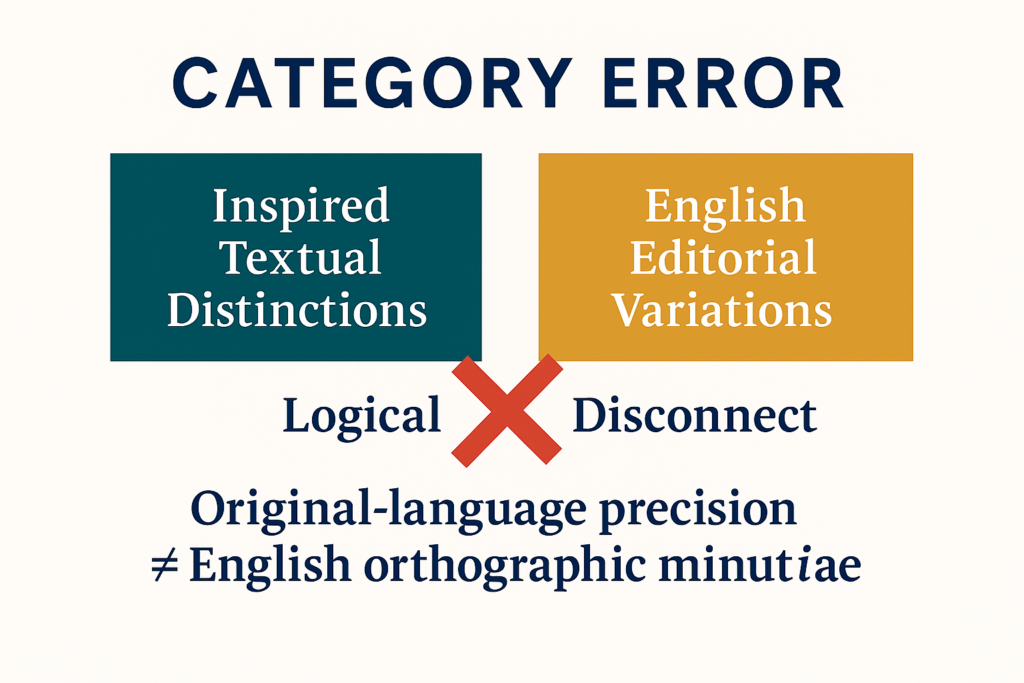
Verschuur uses Galatians 3:16 to argue that every letter in the English PCE matters for doctrine. But this is a category error because the example illustrates the importance of original-language precision, not the necessity of a single exact English edition among many faithful ones. All standard King James Bible editions—and even other faithful translations—reflect the singular/plural distinction in Galatians 3:16. There is no doctrinal difference between the PCE and other KJB editions at this verse.
Thus, the analogy fails: the inspired Greek distinction is not equivalent to spelling differences like alway vs. always or capitalization changes in English.
Logical Disconnect
If Verschuur’s premise were valid, then every orthographic variation in English would carry doctrinal weight equal to the singular/plural distinction in Galatians 3:16. But in reality, variations like stablish vs. establish or punctuation shifts do not alter doctrine in the same way. Therefore, using Galatians 3:16 as proof for PCE exclusivity is non-sequitur reasoning—it does not logically follow.
Why This Matters
This misuse of Galatians 3:16 illustrates a broader flaw in Verschuur’s argument. He conflates inspired textual distinctions (which are doctrinally significant) with editorial refinements in translation (which are stylistic or orthographic). By doing so, he overstates the theological necessity of his position and undermines his claim to logical consistency.
Conclusion
Matthew Verschuur’s appeal to Galatians 3:16 as a defense of the PCE ultimately fails because it misapplies a legitimate textual principle to an unrelated domain. Paul’s argument in Galatians 3:16 demonstrates the theological significance of singular versus plural forms in the inspired Hebrew and Greek texts, not in English orthographic variations. While fidelity to the original languages is essential for doctrinal accuracy, spelling and punctuation differences among King James Bible editions do not alter meaning or theology. By conflating inspired textual distinctions with editorial refinements, Verschuur commits a category error that undermines the logical foundation of his position. This analysis reinforces a critical principle: doctrinal precision depends on the integrity of the preserved original-language text and faithful translation—not on the exclusivity of one English edition. Recognizing this distinction safeguards both sound reasoning and the proper basis for confidence in Scripture.
Pastor Bryan Ross
Grace Life Bible Church
Grand Rapids, MI
Thursday, December 11, 2025