
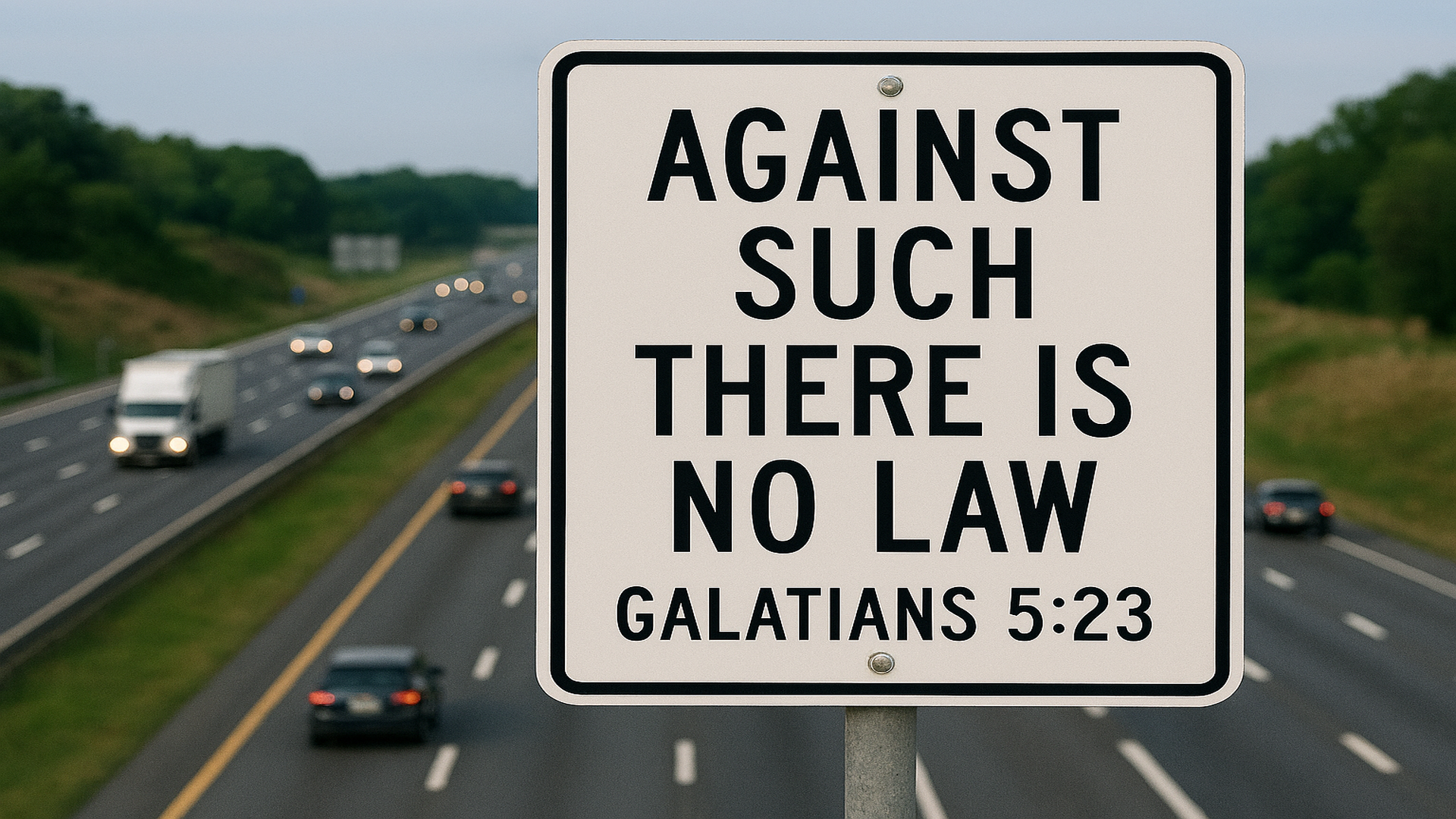
There’s something deeply counterintuitive about the Christian life. We’re told we have liberty, yet we’re called to serve (Gal. 5:13). We’re free from the law, yet we fulfill its deepest requirements (Gal. .5:14). We possess the Spirit, yet we battle the flesh daily (Gal. 5:15-16). How do we make sense of these apparent contradictions?
The answer lies in understanding a profound truth: against the fruit of the Spirit, there is no law.
The Fruit That Fulfills Without the Law
When we examine the fruit of the Spirit—love, joy, peace, longsuffering, gentleness, goodness, faith, meekness, and temperance—we discover something remarkable. These qualities aren’t produced by rule-keeping or performance-based acceptance. They emerge from something entirely different: the life of God’s Spirit working within believers.
The word “against” in Scripture often signals opposition, like teams competing or forces in conflict. But when Paul declares “against such there is no law,” he’s making a revolutionary statement. No law opposes the fruit of the Spirit. More significantly, no law can produce the fruit of the Spirit.
This matters because the Spirit of God never leads believers to keep the law (Gal. 5:18). The Spirit operates on the principle of grace, not law. When we find ourselves or others functioning on law-based thinking—where acceptance depends on performance—it’s not the Spirit leading. It’s the flesh.
Called to Liberty, Not License
Here’s where it gets practical. Believers have been called to liberty. This isn’t a license to serve ourselves or indulge the flesh. Rather, it’s freedom to serve others through love.
Consider this: all 613 laws of the Old Testament can be distilled down to one fundamental principle: love your neighbor as yourself. When believers manifest the fruit of the Spirit and love their neighbors as themselves, they fulfill the law’s requirements without being under the law. That’s the beauty of grace.
The flesh responds to law. Tell someone, “Don’t walk on the grass,” and what’s the first impulse? To walk on the grass. Put up a “wet paint” sign, and people feel compelled to touch it. That’s how the flesh operates—it reacts to prohibition and command.
But the Spirit doesn’t work that way. The Spirit produces fruit through relationship, not regulation.
The Battle Between Flesh and Spirit
Make no mistake: there is a real conflict. The flesh lusts against the Spirit, and the Spirit against the flesh (Gal. 5:17). They’re like opposing poles on a magnet—they repel each other. This opposition means we cannot accomplish spiritual things through fleshly means.
Think of it this way: you can’t fertilize the fruit of the Spirit by following the law. The law only fertilizes the flesh.
Many Christians struggle because they’re trying to live the Christian life through self-effort, performance, and rule-keeping. They’re attempting to use the flesh to please God. It doesn’t work. It can’t work. It will never work.
Crucifying the Flesh
Scripture tells us that those who belong to Christ have crucified the flesh with its affections and lusts (Gal. 5:24). This isn’t talking about our positional standing in Christ—that old man is already dead, crucified with Christ. This is practical, daily reckoning.
The flesh has desires. It wants things. It lies to us, telling us we need certain things to be satisfied, to have fun, to find meaning. These patterns get ingrained in our thinking through years of living apart from Christ.
When someone gets saved at age 40, they have four decades of extracting meaning from life apart from Christ. The moment they believe, their old man is crucified and they become a new creature. But do all those thought patterns disappear overnight? No. That’s the struggle—not between two natures, but between the Spirit and the residual stinking thinking of the flesh.
We need daily software updates, not new hardware. We need to bring our thoughts captive to the obedience of Christ, recalibrating our thinking according to God’s Word.
Making a Million Decisions
Every day we make countless decisions—maybe thousands, maybe more. In each moment, we have a choice: will we respond according to the flesh or according to the Spirit?
We’re responsible for our choices. Not for others’ choices, but for our own. And here’s the grace: even when we choose poorly, we’re already forgiven. But that doesn’t mean we should choose poorly on purpose. The liberty we’ve been given isn’t for self-indulgence; it’s for serving others.
The fruit of the Spirit produces a life that is fundamentally other-regarding. It values and esteems things from the perspective of others, not self first.
The Wonder of Grace
This is what makes grace so wonderful. We don’t have to play religion. We can be real. We can acknowledge that we struggle with the flesh, that we deal with ingrained patterns, that we face temptations and failures.
Until we receive our glorified bodies, we’ll continue wrestling with the flesh. But we don’t have to allow it to have power over us. We can reckon it dead. We can choose to walk after the Spirit, not the flesh.
When we do, something beautiful happens. We begin to manifest love, joy, peace, patience, gentleness, goodness, faithfulness, meekness, and self-control. Not through gritted teeth and white-knuckle effort, but through yielding to the Spirit who indwells us.
And against such fruit? There is no law. No law can produce it. No law can oppose it. It’s the life of Christ, flowing through those who belong to Him, transforming us day by day into His image.
That’s not religion. That’s relationship. That’s grace. That’s the Spirit-filled life.
Pastor Bryan Ross
Grace Life Bible Church
Grand Rapids, MI
Friday, November 21, 2025
Resources For Further Study