
In a world characterized by emotional extremes, heated arguments, and wild swings of passion, there’s a quiet virtue that seems almost countercultural: temperance. This ancient biblical principle offers believers a pathway to stability, credibility, and spiritual maturity that stands in stark contrast to the chaos surrounding us.
Understanding Temperance
When most people hear the word “temperance,” they immediately think of the Temperance Movement of the early 1900s—the campaign to ban alcohol in America. While that historical movement borrowed the term, biblical temperance encompasses something far more comprehensive than abstaining from intoxication.
Temperance, at its core, means moderation. It’s the practice of not being governed by extremes or characterized by excesses. It’s about maintaining a steady course between deficiency and excess, between cowardice and recklessness, between apathy and rage. The Apostle Paul identifies temperance as one of the fruits of the Spirit in Galatians 5:22-23, placing it alongside love, joy, peace, longsuffering, gentleness, goodness, faith, and meekness.
Noah Webster’s American Dictionary of the English Language defines temperance as “habitual moderation in regard to the indulgence of the natural appetites and passions.” It’s about restraint, patience, calmness, and steadiness. A temperate person doesn’t swing wildly from emotional high to emotional low. They maintain equilibrium even when circumstances would justify losing control.
The Biblical Call to Moderation
Scripture doesn’t merely suggest temperance as a nice quality to have—it commands it. Philippians 4:5 instructs believers: “Let your moderation be known unto all men.” This isn’t a private virtue to be practiced in isolation. It’s a public testimony, a visible characteristic that should mark believers as different from the world around them.
Think about what this means practically. When unbelievers observe Christians, they should see people characterized by stability, not volatility. They should witness individuals who respond to crisis with calmness rather than panic, who face uncertainty with faith rather than fear, and who engage in disagreement with grace rather than hostility.
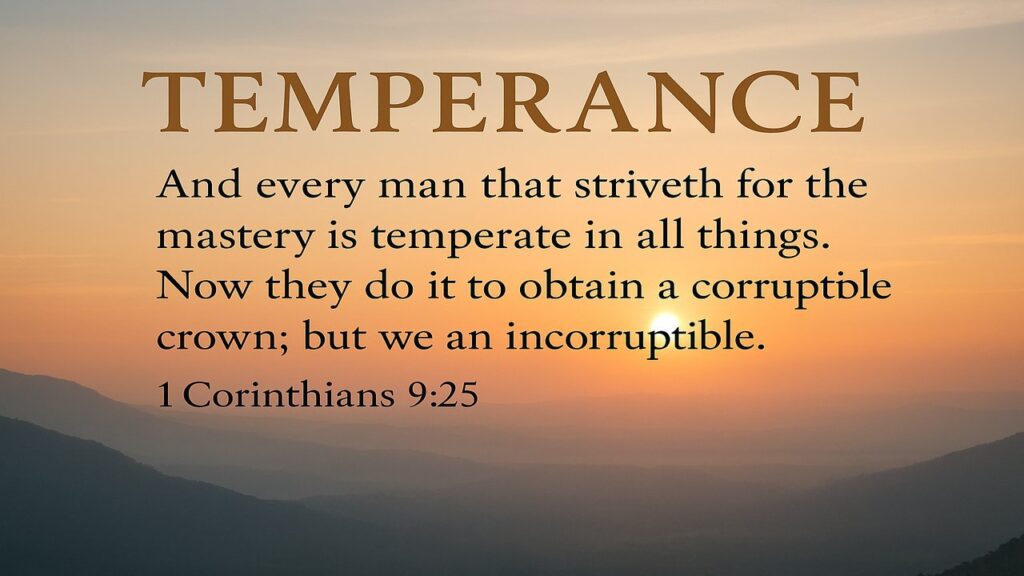
The Apostle Paul understood this principle intimately. In 1 Corinthians 9, he uses the illustration of an athlete training for competition. He writes, “And every man that striveth for the mastery is temperate in all things. Now they do it to obtain a corruptible crown; but we an incorruptible” (1 Corinthians 9:25).
Just as athletes discipline themselves in every area of life to win a perishable prize, believers should exercise even greater discipline for an eternal reward. Paul wasn’t merely talking about physical training—he was describing a lifestyle of spiritual discipline that touches every aspect of existence.
Temperance in Church Leadership
The Apostle Paul places particular emphasis on temperance as a qualification for church leadership. In Titus 1:7-8, elders must be temperate—not given to excess, not characterized by emotional instability, but marked by moderation and self-control.
Similarly, Titus 2:2 instructs that “the aged men be sober, grave, temperate, sound in faith, in charity, in patience.” Why this emphasis on older men? Because younger men naturally tend toward being governed by passion and emotion. They need models of stability and moderation to follow.
This creates a beautiful intergenerational dynamic within the body of Christ. Older believers who have cultivated temperance over years of walking with God become living examples for younger believers who are still learning to master their impulses and emotions. Every member of the church has a role to play in this mutual edification.
The Opposite of Temperance
To truly appreciate temperance, we must understand what it stands against. Galatians 5:19-20 lists the works of the flesh: “adultery, fornication, uncleanness, lasciviousness, idolatry, witchcraft, hatred, variance, emulations, wrath, strife, seditions, heresies.”
Notice particularly the middle section: hatred, variance, wrath, strife, seditions. These are the opposites of temperance. They represent passions running hot, relationships marked by conflict, and lives characterized by instability and anger. When believers find themselves constantly angry, argumentative, and emotionally volatile, they’re operating in the flesh rather than in the Spirit.
The Threat of Unsound Doctrine and Evil Surmisings
One of the greatest threats to temperance in contemporary Christianity is unsound doctrine coupled with what Scripture calls “evil surmisings” (1 Timothy 6:4). Evil surmisings are suspicions or imaginations entertained without sufficient evidence—essentially, conspiracy theories and unfounded speculations.
When believers consume a steady diet of sensationalized predictions, apocalyptic speculation, and conspiracy theories, it destabilizes them. They become characterized by fear, anxiety, and emotional reactivity rather than peace, faith, and stability. Sound doctrine, by contrast, produces sound thinking, which leads to the ability to be moderate and temperate.
The instruction from 2 Corinthians 10:5 is clear: we are to cast down imaginations and every high thing that exalts itself against the knowledge of God, bringing every thought into captivity to the obedience of Christ. This isn’t passive—it requires active discipline over what we consume, what we think about, and what we allow to influence our minds and emotions.
Temperance as a Relational Virtue
While all the fruits of the Spirit have relational implications, temperance seems particularly focused on how believers are perceived by others. If meekness governs how we treat people, temperance governs how people experience us.
When colleagues, neighbors, and family members observe believers, what should they see? Not people who are constantly worked up about the latest crisis or conspiracy. Not individuals who fly off the handle in angry outbursts. Not unstable personalities who swing from one extreme to another.
Instead, they should see people characterized by stability, moderation, and self-control. Even when they disagree with a believer’s convictions, they should respect the manner in which those convictions are held and expressed.
Practical Application
So how do we cultivate temperance in our daily lives? It begins with what we consume. Just as adding hot butter too quickly to eggs scrambles them, consuming too much inflammatory content scrambles our thinking and emotions. We must be selective about what news we read, what social media we engage with, and what voices we allow to influence us.
It continues with what we prioritize. When Scripture takes precedence over speculation, when prayer supersedes panic, and when faith overcomes fear, temperance naturally follows.
Finally, it requires honest self-examination. When we find ourselves constantly upset, angry, or emotionally volatile, we must ask whether we’re walking in the Spirit or in the flesh. The fruit of the Spirit is temperance—and that fruit should be increasingly evident in our lives as we grow in grace.
In a world that seems increasingly extreme, believers have the opportunity to stand out as beacons of stability, moderation, and peace. That’s the power of temperance.
Pastor Bryan Ross
Grace Life Bible Church
Grand Rapids, MI
Friday, November 13, 2025
Resources For Further Study
74) Galatians 5:23 The Fruit of the Spirit, Part 10 (Temperance)